Heart going. Nothing happening.
Head pounding. Brain on a loop.
Science-backed recovery for the days you are running below baseline. A big night, a long flight, a run of short nights, a day that took everything.
- No trackers
- No journaling
- No lectures
- Zero judgment
Checkout opens soon
Then $99 a year, or $14.99 a month. Cancel any time.
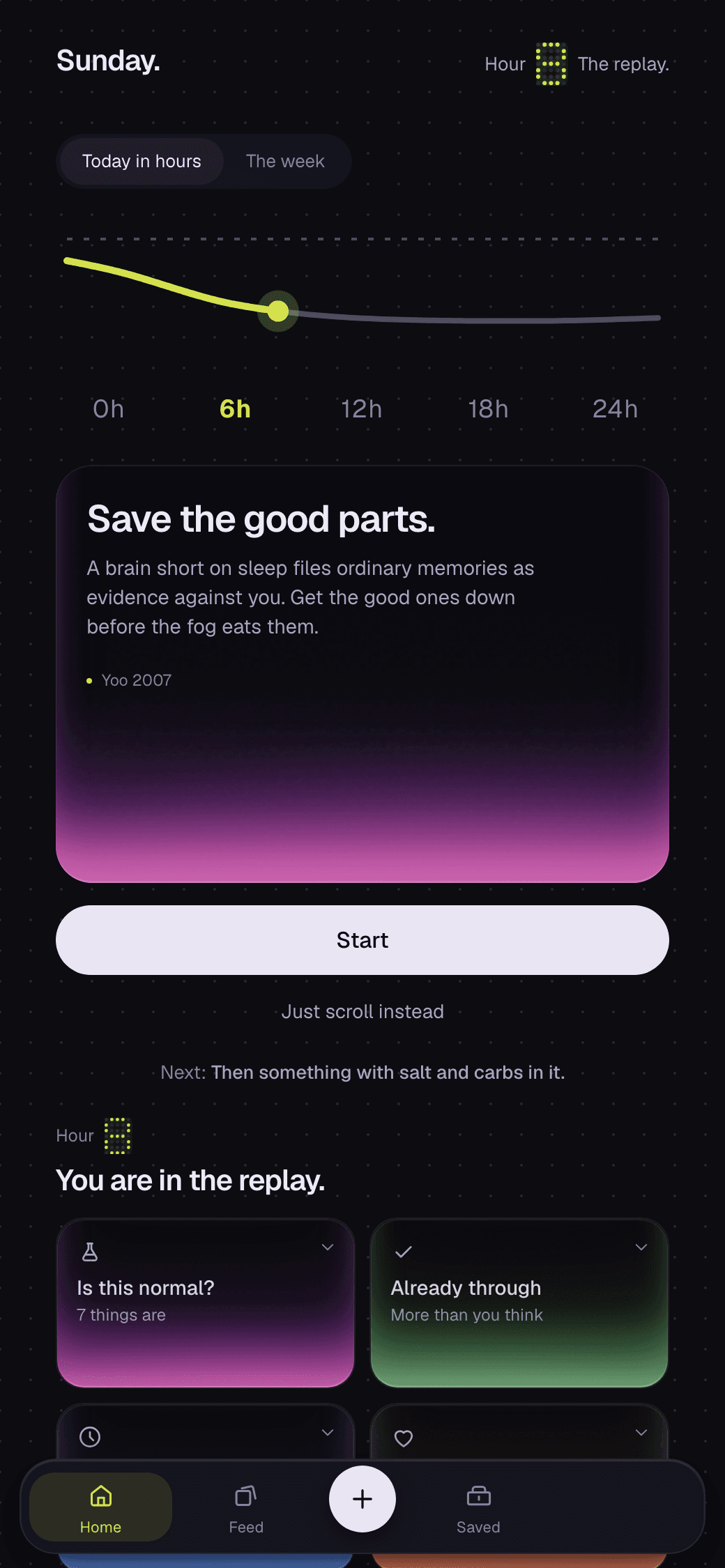
Work is stressful and you earned your weekend. The pain, the garbage sleep, the dehydration, the dread. It is biology, not brokenness.
Read the 35 papers behind itWe know exactly where you are.
It asks twice. Body, then head. Eight seconds, whatever put you here.
Too tired to sleep. Somehow both.
You've reread it four times.
Something's wrong. You don't know what.
Nothing is interesting. You checked.
You feel fine. You know it is coming.
Then it hands you what the research says helps that exact state, at the hour you are in it.
Four ways to end up under your own line.
Each one gets its own week, its own hours, and its own papers. It never asks what any of them involved.
A big night
Six bands from waking to lights out, then the dip that lands on day two and catches almost everyone.
Blankers et al., Drug and Alcohol Dependence 2025A long flight
It asks which way you flew, because the same daylight that fixes one direction makes the other worse.
Khalsa et al., The Journal of Physiology 2003A run of short nights
On four hours you keep rating yourself as fine while the measurements say otherwise. Worth knowing before Monday.
Van Dongen et al., Sleep 2003A heavy day
A wedding, a funeral, a conference. Recovering splits into four separate things and rest is only one of them.
Sonnentag and Fritz, Journal of Occupational Health Psychology 2007One subscription, four protocols. You will use it more weeks than you think.
Three taps to feeling human.
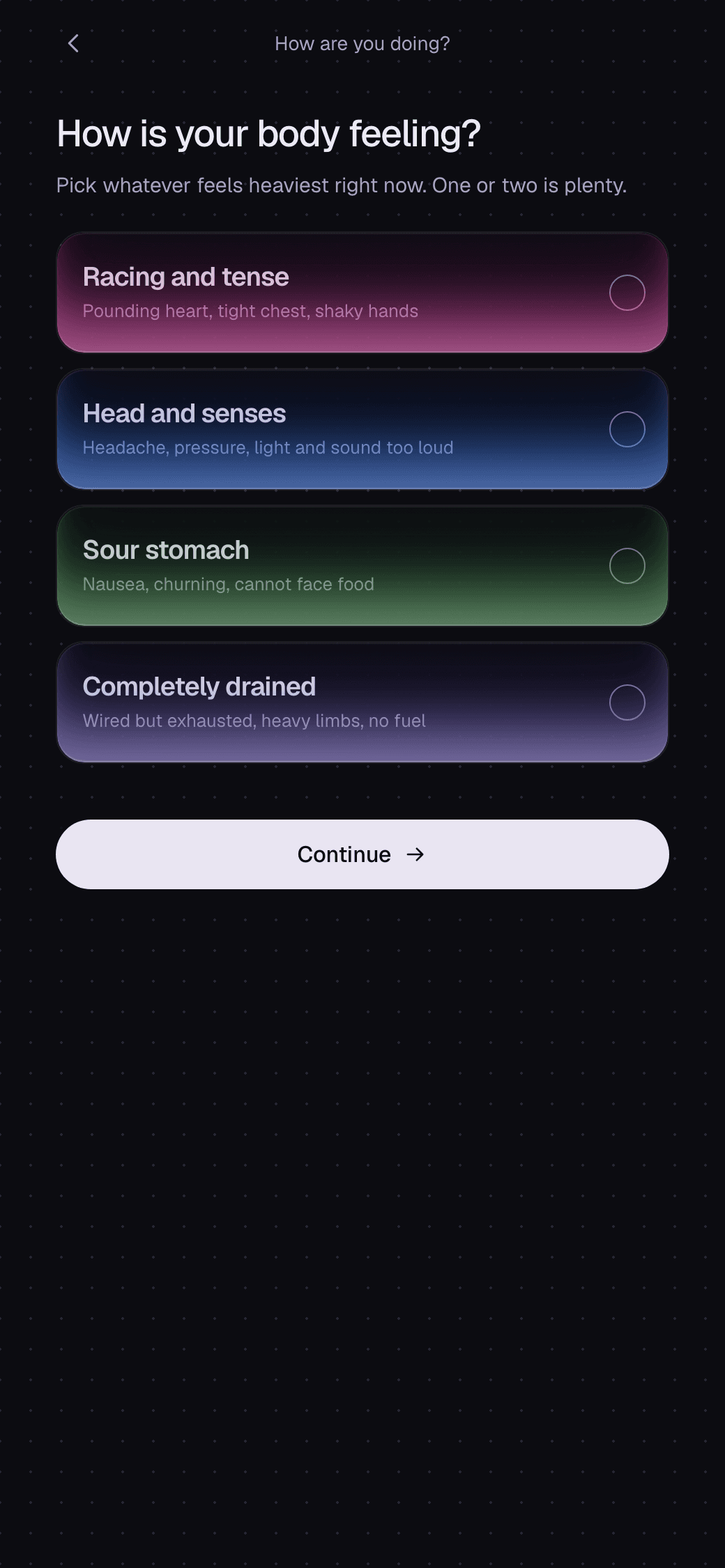
Tell it where you are
Two taps, no typing. It never asks what you took, and it never will.
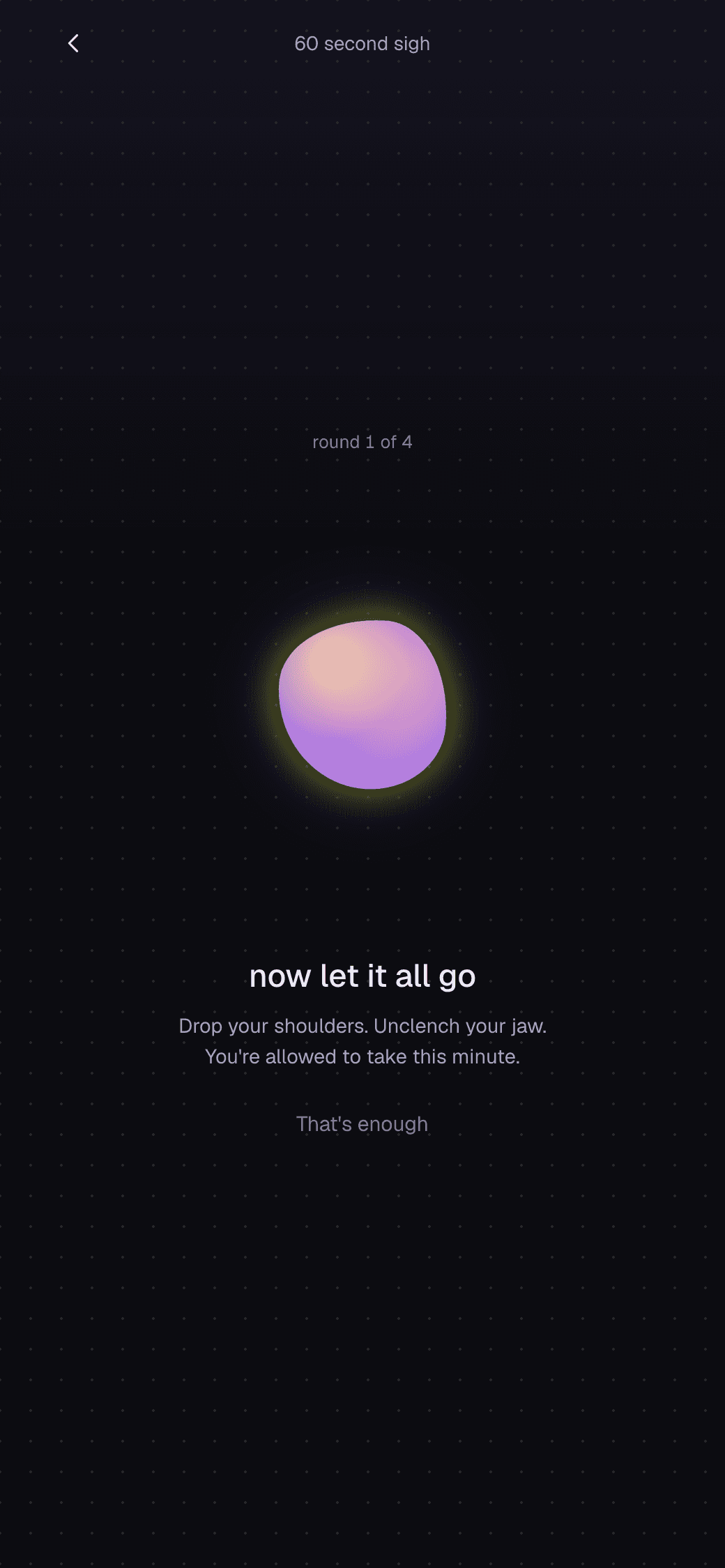
Stop the spin
One tap starts a sixty-second breathing cue that settles your heart rate and eases the physical panic.
See where you are
Hour by hour. What helps at this exact point, and the paper it came from.
Sunday is not the bottom. Tuesday is.
Most people brace for the morning. Then Tuesday flattens them.
The loud partFirst 12 hours
The replayDay 1 to 2
The flat daysDay 2 to 3
Coming backDay 4 to 7
244 people logged their mood every day for five weeks. The dip runs about three days.
You get the day back.
Not fixed. Not lectured at. Not tracked. Just steadier, sooner, and told the truth about what the rest of the week is going to do.
And the part that matters most: you stop reading a rough morning as evidence about who you are. It is biology, not brokenness.
Every claim links to a paper.
35 of them in the app. Four here, so you can see the kind of thing we mean.
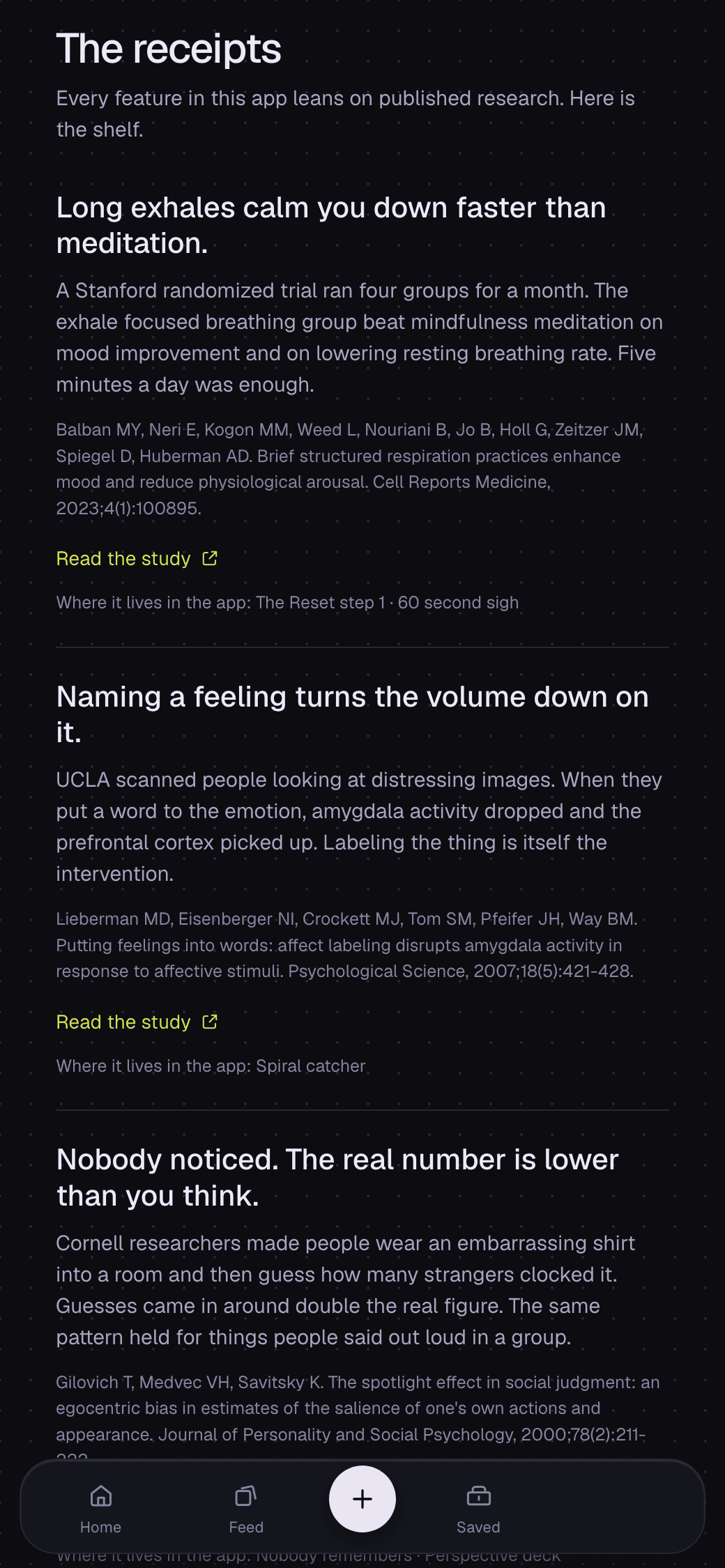
Stanford ran breathing against meditation for a month. The long exhale won, on mood and on resting breathing rate.
60 second sighRead it
Balban et al., Cell Reports Medicine 2023;4(1):100895
97 social drinkers, one ordinary night out. Next morning, the shyest reported the sharpest spike. This is the paper that put the word in the literature.
The dip clockRead it
Marsh et al., Personality and Individual Differences 2019;139:13-18
244 people, one mood question a day, five weeks. Mood dropped about three days. It held after controlling for sleep.
The flat daysRead it
Blankers et al., Drug and Alcohol Dependence 2025;276:112881
Two weeks of short nights built up deficits the size of a night with no sleep at all. People rated themselves as barely affected the whole time.
After short nightsRead it
Van Dongen et al., Sleep 2003;26(2):117-126
If something cannot be sourced, it gets labelled as a way of reading it and claims nothing.
Seven days free. Then $99 a year.
Cancel any time in those seven days and you are not charged. No form, no call, no talking anyone out of it.
Every tool, from day oneincluded
The 48-Hour Map, emailed when you joinincluded
The research shelf, all 35 papersincluded
Works offline, alwaysincluded
Monthly$14.99a monthAfter 7 free days. Cancel any time.
Yearly$99a yearWorks out at $8.25 a month. Saves 45% against monthly, and $129 is what it costs after the founding group closes.
Checkout opens soon
Less than one IV drip, for a whole year.
Cancel any time in the first seven days and nothing is charged.
$129 a year once the founding group closes
Before you decide.
Is this a sobriety app?
No. It has no opinion about your night. It is for the morning after, and the week after that.
Am I charged today?
No. The first seven days are free. Your card is held by Stripe and charged $99 for the year, or $14.99 for the month, on day eight unless you cancel before then. Cancelling is one link, and it is in the email you get the moment you sign up.
Is any of this medical?
No. It cites research. It does not diagnose you or treat you. If something is not lifting, it says plainly that a real person is worth talking to.
Do not make big decisions today.
That one is free, and it is the best line in the app. This one is not a big decision either. Seven days, and you can walk away from all of it.
Checkout opens soon
Then $99 a year, or $14.99 a month. Cancel any time.
Not ready?
Take the 48-hour map instead. It is the whole timeline, hour by hour, with the papers it comes from. Free, and it arrives in about a minute.
One email. No sequence you have to escape from.
Seven days free, then $99 a year or $14.99 a month, billed through Stripe. Cancel any time before day seven and you are not charged.
AFTERS is a wellness product. It is not medical care, and it does not diagnose, treat, cure or prevent any physical or mental health condition.
AFTERS · Questions: smile@pebo.co